Saturday, 25 August 2012

V is for Hyades

“V” may be for Victory, but it’s also the shape of one of the closest star clusters to Earth: the Hyades. Located in the constellation Taurus, finding this star cluster is easy-peasy - the brightest stars in the cluster make a distinctive 'V' or arrowhead shape and it is located south of its more well-known half sisters, the Pleiades, or Seven Sisters. The Hyades are 'only' about 150 light years from our solar syste - the Pleiades, for example, is three times farther or about 400 light years away.
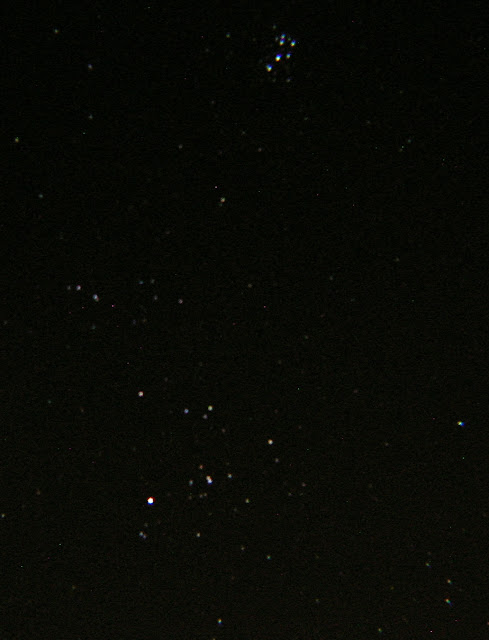
The first star to catch your eye in that V shape will be a bright orange spark to the bottom left - the 'eye' of the Taurean bull. This is the red giant pictured below, Aldebaran  - a star that is approximately 50 times the diameter of our Sun.   Aldebaran is actually not part of the Hyades star cluster at all. It’s only 65 light years from Earth (that is, almost halfway between us and the Hyades) but coincidentally happens to be in the foreground of our line of sight to the Hyades. That said, without Aldebaran, the cluster would be a little disappointing; so it does adds a little lustre to it and helps anchor the overall shape of the cluster for us astronomers. The name Aldebaran actually comes from Arabic (al-dabaran) and translates literally as "the follower", presumably because this bright star appears to follow the Seven Sisters in the night sky - in which case, perhaps 'Stalker' might have been a better word! For the Seris of northwestern Mexico, Aldebaran is said to provide light for the seven 'women' giving birth. And those Trekkers among you probably know of one of Scotty's favourites, the Aldebaran whiskey and the Aldebaran mud leeches used by the Denobulan Dr Phlox!


The Hyades contains about 20 orange and blue stars that are perhaps visible to the naked eye; If you like double and binary stars, you'll love Hyades - as you can see from the image below, the Hyades cluster has quite a few pairs in it. Even with average eyesight, you can probably make out and split with tree pairs without any difficulty - the Sigmas (just a little to the south pf Aldebaran), the Thethas (to the east) and the Kappas (way up north).


While  the cluster appears like the letter “V” from our perspective on Earth, its true shape is approximately spherical.  And while we may be able to observe about 20 stars visually, the Hyades actually contains some 300-400 stars. Below is a 'stacked' enhancement of the image above, which clearly show a lot more stars than is evident at first.


All photographs on this page  © Sabri Zain 2012.


Friday, 17 August 2012

My date with the Seven Sisters

The Pleiades is an open star cluster in the constellation Taurus and, at this time of the year, makes its entrance in the north eastern skies of the northern hemisphere round about midnight. Popularly called the Seven Sisters, it is among the nearest star clusters to Earth and is the cluster most obvious to the naked eye in the night sky.


These stars are so clearly seen in the night sky that even those who do not dabble in astronomy can easily spot them - at least 6 or 7 bright stars, gathered in a region only a bit larger than 1 degree, are clearly seen with the naked eye. See the little cluster of stars near the bottom right hand side of the picture below?


The Pleiades have been used for testing eyesight from antiquity onward. In good observing conditions, an observer with average sight can see 6 stars. What about people with excellent eyesight? Maestlin, the teacher of the astronomer Kepler, saw 14 stars; he had drawn 11 stars on charts of the Pleiades before the telescope was invented! The well-known English observer Denning also saw 14 stars in the cluster. Madame Airy (the wife of a well-known nineteenth-century English Astronomer Royal) could see 12, while the English amateur astronomer William Dawes, who was in his time known to have extraordinary eyesight, saw 13 stars in the cluster. How many can you make out in my picture below?


If the Pleiades seem charming with the naked eye, they are truly breathtaking when viewed through a small low-powered telescope  or binoculars! The six stars are suddenly joined by numerous fainter ones, making the field of the cluster literally overflowing with stars, as you can see in my image below. Investigations of the cluster have shown that it may actually contain approximately 500 stars.


If I'd always felt slightly deprived because of the relatively low magnification of my telescope set-up, when observing the Pleiades low magnification becomes an advantage. The large field of view of a small refractor offers a panoramic view of this splendid group. With larger amateur telescopes or at high magnifications, we somewhat lose the magnificent feel of this cluster. Below is an image of the centre of the Pleiades taken at high magnifications.


In Greek mythology, the Pleiades were the seven daughters of the titan Atlas and the sea-nymph Pleione - Maia (the eldest), Electra, Taygete, Alcyone, Celaeno, Asterope and Merope (the youngest). However, because most people can only see six of the Seven Sisters, this has inspired legends of the “Lost Pleiad.” The most commonly told is that Electra - she’s shocked to see her home city Troy burning and hides her face. Another story says Merope wasn’t made as bright as the others because she married a mortal - the other sisters married immortals. Yet another story says she couldn’t fit in with the other sisters anymore and left for Hades. In another story, a thunderbolt hit Celaeno and she disappeared.


Intriguingly, other cultures such as the Aborigines of Australia and Iroquois of North America had similar legends of a missing seventh star. Some modern astronomers think that means there may actually have been seven stars easily visible a long time ago. The Greeks, the Iroquois, and the Aborigines may have told stories appropriate for their own cultures to explain why one vanished. If that’s true, one of the many Pleiades we see in a magnified view could have been the one that faded from naked eye visibility.

All photographs on this page  © Sabri Zain 2012.


Wednesday, 15 August 2012

Twin Terrors


Sunspots look like pimples on the face of the sun. In the case of the sun, though, it's acne problem occurs every 11 years, the cycle starting with a few pimples and building up to an outburst of blotchy rashes at its peak. Fortunately for me, the sun is currently in an active phase of its 11-year solar cycle. That's why last weekend saw the sun firing off one of the year's more spectacular solar eruptions, with super-hot solar filaments erupting and arcing into space and snaking between two huge sunspots - AR 1538 and AR 1540. Below is a video I took yesterday of these two sunspots. It may look like a single dark blob at first but careful inspection of the video will reveal that the 'blob' actually consists of a pair of sunspots.


Processing the video above with an astronomical image stacking program such as Registax reveals the two sunspots in greater detail, below. The two sunspots appear quite identical, like two evil twins spitefully spewing deadly plasma a (as well as a much smaller sunspot to the south) nd radiation towards poor little Earth. Sunspots are basically magnets - well, magnets with the magnetic force perhaps 8,000 times greater than the magnetic field around our entire planet. But just like any magnet, it has opposite north and south poles of positive and negative force. Sunspots therefore tend to form in pairs, just like the ones I captured in my images above - one with negative and one with positive polarity. The twins are often side by side, parallel with the equator and they rotate with the sun from west to east.


Zooming in on the sunspot with a 2X Barlow lens, you can see more clearly below the two dark spots (the central umbrae, where the magnetic field is approximately vertical to the Sun's surface), as well as the surrounding penumbra, which is lighter, where the magnetic field is more inclined.


Astronomers expect the current solar cycle, known as Solar Cycle 24, to peak in 2013, so probably lots for me to observe and video capture for quite a while yet - stay tuned!

All photographs on this page  © Sabri Zain 2012.

Sunday, 12 August 2012

Due to bad weather, the Meteor Shower has been cancelled!

The Perseids are a prolific meteor shower associated with the comet Swift-Tuttle and so-called because the point from which they appear to come, called the radiant, lies in the constellation Perseus. This weekend was supposed to be the peak period of the Perseids, where the rate of meteors reaches 60 or more per hour - a meteor a minute! But being England, the skies were of course shrouded with blankets of cloud and what was supposed to be a meteor shower turned out to be hardly a meteor drizzle - I could hardly see no more than half a dozen in three hours of gazing in between the angry rolling clouds above. Nevertheless, I did manage to capture half a dozen interesting images from last night:


You can see from some of the images above that many are framed to a gorgeous background of other bright objects such as Capella, Jupiter and the Pleiades. But you will also some of the terrible cloudy conditions - made worse by the hideous orange glare of the street lights below and the floodlights from the useless guided bus station nearby. Why anyone would spend thousands of pounds a year floodlighting an empty bus station at 2 o'clock in the morning is beyond me - with business sense like this, it probably explains why this country up to its eyeballs in debt to China.

I took the above images using the time lapse photography techniques I described in my earlier article 'How to catch falling star.', using 8-second exposures for each shot  However, I also had another camera taking much faster exposures and one result of this is a meteor suspended in mid-flight, below.


Below is a magnified and 'cleaned up' version of the bright 'star' to the far let.


And how do I know the above is a blazing meteor and not just a particularly large and bright star? Because below is a shot of exactly the same position a couple of seconds later:


I'm also pretty sure it wasn't a plane either, as the 'blip' does no appear again in subsequent frames. Neverthless, when taking time lapse photographs of meteors, you should certainly make sure that the meteors you capture aren't actually aircraft, as they would leave a similar streak of light in your frame. There are two ways telling the difference. Firstly, for an 8-second exposure, a plane would leave a 'streak' that would appear in subsequent frames, whereas a meteor would only appear in one frame. Secondly, a plane would leave a distinct dotted line streak as pictured below (since the navigation lights are usually red and white).


The picture below, on the other hand, is not a plane or green meteor hurtling its way to the top of my telescope - it's just the beam from the laser I have mounted on top of my scope that I use to aim at my target star.


Below is the set-up I used for last night night's observations. There's a camera mounted on a tripod scanning the  eastern horizon and an identical camera mounted on my telescope scanning the northern horizon (much of the time, I had to run from one camera to the other, swivelling the cameras to different directions, depending upon where there was an opening in the clouds). Two laptops are connected to the cameras to take the time lapse photographs automatically and save the images to hard disk. And, of course, there's a nice warm tent to retire to with a hot cuppa while the cameras and computers do all the work!


Rishon also joined me in my observations, as this was also the night we allowed him sleep out in the garden in the tent for the first time. However, despite the long afternoon nap he took earlier, staying up to after midnight was just too much for his poor little eyes and, thanks also to the cloudy skies, he fell asleep before he could see a single shooting star. He was quite inconsolable when he woke up the next morning, and the only thing that stopped the bawling was when I told him that he didn't really miss anything as there was announcement in the news this morning that last night's meteor shower had been cancelled due to cloudy weather!


All photographs on this page  © Sabri Zain 2012.

Thursday, 31 May 2012

In the shadow of the Terminator


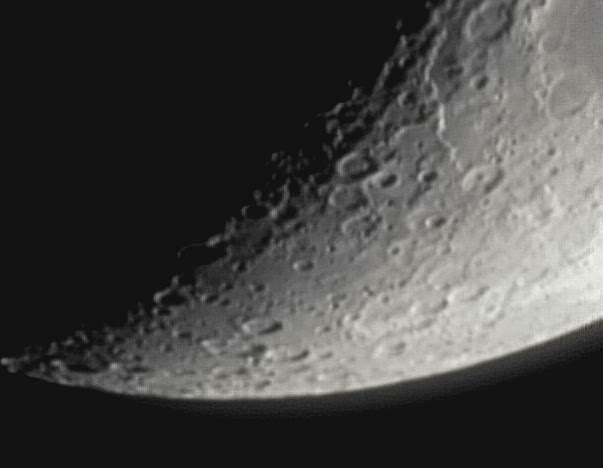
You might think that the best time to observe the moon is when it is at it's brightest - during the full moon. Actually, that's probably the worst time to see the moon. When the moon is full, it tends to be dazzlingly bright as well as flat and one-dimensional in appearance. All the detail of craters, mountains and valleys will be completely washed out by the dazzling light. In contrast, the interval when the moon is at or just past first quarter phase, or at or just before last quarter phase, is when we get the best views of the lunar landscape - and the best views can be seen right along the sunrise-sunset line, or terminator - the line between the illuminated portion and the part of the moon in shadow.)


 Just looking at the image of the moon above, you can see that the topographies of the northern and southern hemispheres of the moon are quite different. The top half consists mostly of the lunar plains called maria (singular mare), the Latin for seas. They got this name from early astronomers who mistook their wide, dry, airless expanses for earthly seas - they are actually large, dark, basaltic plains, formed by ancient volcanic eruptions. There are also a few craters which are small and circular. However, as you move south to the bottom half of the moon, it gets lighter in color, and will consist mostly highlands, covered with many more large, complex craters. 

Let's start with this image of the northern pole of the moon below.


You'll see a few small, round craters, such as Democritus and Galle. Democritus is only about 25 miles in diameter, while Galle is about 21 km wide. Both craters are nearly circular, with sharp-edged rims and little appearance of erosion. They are located in a wide plain known as Mare Frigoris (the "Sea of Cold"). However, southeast of Galle, in the shadow of the terminator, you will just about see a much larger crater, Aristoteles. This crater is 87 km in diameter and the small crater on the right immediately under Aristoteles is Mitchell. An arc of mountains separate these craters.

Head a little further south in the northern hemisphere and you'll see two very interesting craters below.


Ritter, at the bottom of the image above, is a lunar crater located near the southwestern edge of Mare Tranquillitatis (Sea of Tranquility). It is the northwestern member of a crater pair with Sabine to the southeast. The two rims are separated by a narrow valley only a couple of kilometers wide. The Sea of Tranquility is actually quite special because it was the landing site for the first manned landing on the Moon - the area just to the east of Ritter and Sabine. After making a smooth touchdown in the Apollo 11 Lunar Module named Eagle, astronaut Neil Armstrong told flight controllers on Earth, "Houston, Tranquility Base here. The Eagle has landed." 

Another interesting feature in the image above is Plinius - a prominent lunar impact crater on the border between Mare Serenitatis (Sea of Serenity) to the north and Sea of Tranquility to the south. If you look carefully at this crater, you might be able to make out a central peak right in the middle of the crater floor. This centrla peak is more evident in the zoomed image of Plinius below.


How was this central peak formed? Well, if you drop something into a pool of water, you will get a rebound effect in the middle where the object was dropped, and then waves will spread out around it. This rebound effect in the middle is the same phenomenon that causes central peaks in craters. the central peaks are formed by rock rebounding, being pushed back up by the strength of the underlying rock after the initial impact event. An impact that forms a crater on the moon that is greater than 15km will cause the rock to act like the liquid to the point that you get the rebound effect and form a central peak. Smaller craters  will not have central peaks, and larger craters above 120 km will form a ring of peaks. Central peak formation happens within minutes of the impact itself. 

Head further south into the southern hemisphere and you will more clearly see more of these central peaks in the image below. 


Theophilus is a prominent lunar impact crater that lies between Sinus Asperitatis (Bay of Roughness) in the north and Mare Nectaris (Sea of Nectar) to the southeast. It partially intrudes into the comparably sized crater Cyrillus to the southwest. To the east is the smaller crater Mädler. The floor of the Theophilus is relatively flat, and it has a large, imposing central peak which is 1,400 meters high.

And as you head to the southern pole, you'll see the basalt plains make  way for more rugged highlands that are pock-marked by hundreds of craters - indicating that this part of the moon once endured some heavy battering at one time in the very distant past.


All photographs on this page  © Sabri Zain 2012.

Sunday, 27 May 2012

Colliding Galaxies


If someone were to ask you how far you would be able to see with the naked eye unaided, what would your answer be? A couple of miles, at best? Well, the answer is actually 14,696,563,432,959,020,000 miles - that's 14.7 quintillion miles. This is because it is possible for anyone to see, with the unaided eye and without the use of a telescope or binoculars, our nearest neighbour galaxy - the Andromeda Galaxy, which is about 2.5 million light years from us.

Now, it would have to be a really clear, dark, moonless sky for you to see it. And even then, all you'd probably see would be a faint smudge. Even with a small telescope such as mine, you'd be able to make out it's shape but it would still appear as a fuzzy white patch in the sky. But just the thought that you are looking at a patch of light that took two and a half million years to reach you and is many quintillion miles away - well, that just blows my mind! And you're not just looking at another planet or star - that is a whole new galaxy, just like our own Milky Way! Below is a photograph I took of Andromeda last night, over the northeastern skies of Longstanton - my first photo of a galaxy! It;s that fuzzy cloudy 'star' near the centre of the picture.


While the Andromeda Galaxy is pretty easy to see in a telescope, because it is just a fuzzy patch, taking the photograph above was deuce difficult. CCD cameras for small telescopes are also called lunar planetary imagers - which means they're primarily designed to capture images of the moon and a few planets. To capture stars, they'd have to be pretty bright - at least magnitude 5 or less. So fuzzy patches would be impossible. I had to use my Olympus Camedia C4040Z digital camera afocally with the eyepiece. To get decent pictures of fuzzy deep sky objects with a camera, you'd need long exposures - typically, at least a few minutes. My ancient C4040Z unfortunately has a maximum exposure time of just 16 seconds. To make up for the lack of long exposures, I squeezed as much wide aperture as I could out of the camera (1.8) and used the maximum ASA available (400). There was quite a bright crescent moon out as well, and I was observing about an hour before dawn, so seeing conditions were far from ideal.

Now, if I had a telescope such as the WIYN 0.9-meter telescope at the Kitt Peak National Observatory in Arizona, I would not need all the fuffing about with exposures, apertures and film speeds. The picture of the Andromeda Gakaxy below was taken by the WIYN 0.9-meter telescope. And just to give you some perspective of the size of that - that telescope's 12 times bigger than mine, has banks of CCD imagers built into it and cost half a million US dollars!


Andromeda is not only the closest galaxy to the Milky Way - it's also moving closer to us every day! Andromeda and our Milky Way are hurtling towards each other at about 70 miles per second. But before you have sleepless nights fretting about alien suns and planets crashing into your garden shed one night,   astronomers estimate that this galactic collision with Andromeda will probably take place about 5 billion years from now. By that time, our Sun would have swollen into a red giant and swallowed up the inner Solar System planets, so Earth will have other things to worry about!