Saturday, 22 September 2012

The Orion Nebula


You know that the summer is gone and winter is not too far off when the Orion constellation once more adorns our night sky in all its glory. If you want a friend, acquaintance or even your six-year old son to become enraptured with backyard astronomy, there are four things you should show him through your telescope - the Moon, Jupiter, Saturn and, the crowning jewel of them all - the Orion Nebula.

Even the non-astronomer will probably be able to spot the famous line of three stars pictured below, known as Orion's Belt. Just below that 'belt' is another line of stars - Orion's Sword, and the Orion Nebula is right in the middle of that 'sword'.


'Just' 1,300 light years away from us, the Orion Nebula is the closest nebula to us, and the brightest, so it can be seen with the naked eye. What you'll probably see is pictured below - a tenuous, but clearly visible, hazy patch of light. a few rather bright stars. These stars are what illuminates the clouds of dust and gases of the nebula, which otherwise would not be visible at all. The brightest of these stars are Theta–1 and Theta–2.


With a telescope, though, and in good observing conditions, you will be able to see the full extent of the nebula and perhaps even glimpse it's greenish blue hue, perhaps even a reddish tint. 


However, you will need either time-lapse or long exposure photography to view the nebula in all its colour and glory. The picture at the top of this article was produced using afocal photography, viz. a camera attached by adapters and T-Rings to a 26mm eyepiece on the telescope and operated remotely by computer. I took 24 exposures, with each exposure lasting 3 seconds (to minimize the star-trailing), and the 24 images were then 'stacked' together  


in black and white, as in the picture below, you can see that the contrast improves and one can actually make out the areas of swirling black clouds of nebular gas.


The nebula is a vast, cold cloud of gases and dust that does not emit light and is composed mainly of hydrogen (91%), helium (9%), carbon (0.05%), oxygen (0.02%), and nitrogen (0.02%), as well as smaller quantities of sulphur, neon, chlorine, argon, and fluorine. The gases and dust reflect the light of the nearby stars, but in the vicinity of the hot young stars the gases in the nebula are excited by the ultraviolet light emitted by these stars and so emit their own light. Although the nebula may appear tenuous and transparent, this 'clouds' actually contains the matter of 10,000 Sun-like stars! It is from such 'clouds' that stars like our sun and even planets like ours are 'born' and the Orion Nebula has revealed much to astronomers about the process of how starsand planetary systems are formed from collapsing clouds of gas and dust.

All photographs on this page  © Sabri Zain 2012.

Mystery object passing Jupiter


While taking a series of four 3-second time lapse photographs of Jupiter and its moons on Thursday night, I captured an object moving which I cannot fully explain. You can see the object moving below Jupiter in the video above, moving in the opposite direction of Jupiter rising in the night sky. This series of pictures was taken over a period of about two minutes, so it's too slow or distant to be an earth-bound aircraft. It is headed in the opposite direction as the motion of the night sky, so it's not a star or solar system object. And it's not a reflection of light on the lens, hot pixel or other photographic artefact, as these would be stationary and not appear to move. So what in the Universe could it be? The mind boggles.

Below are the four photographs taken, so you can have a closer look and perhaps help me work out what exactly that object is. These were taken afocally,  viz. a camera attached by an adapter and T-Ring to a 26mm eyepiece on the telescope and operated remotely by computer. Each exposure was for 3 seconds. Unfortunately, I could not take any further photos of the object, as it had gone past the eyepiece's field of view after the fourth shot.


All photographs on this page  © Sabri Zain 2012.

Sunday, 9 September 2012

In search of the Galactic Plane


Almost everyone knows that the galaxy our Solar System is located in is called the Milky Way but a lot of people don't realize that you can actually see the Milky Way from the comfort of our Earth-bound back gardens. Well, obviously not the whole of the Milky Way galaxy - you'd have to be well outside of the galaxy, in a starship or some alien observatory in the Andromeda Galaxy, to do that. What we can actually see is the Galactic Plane of the Milky Way - the plane in which the majority of our galaxy's mass lies. 

Every star you see in the night sky is part of the Milky Way but you can also see a hazy band of 'milky' white light (hence the name of our galaxy) some 30 degrees wide arcing across the sky.   The Galaxy appears like a band (as seen in the photograph below from the European Organisation for Astronomical Research in the Southern Hemisphere in Chile) because that's what you see when a disk-shaped structure is viewed from inside. And you don't even need a telescope to see it - your trusty Mark 1 eyeballs are the best optical equipment to use.


However, if, like me, you are living in or near a city such as Cambridge or even a suburb such as Longstanton, the chances are it will be almost impossible to see. The light pollution from from street lights, buildings, houses and vehicles will completely wash out any of the Milky Way's white 'haze' (not to mention a good number of normally visible stars). Bright moonlight would make it even more difficult to see and if it's cloudy, well, you might as well go inside and watch the 'The Sky At Night' on the BBC instead.

To illustrate, the picture below was taken outide my house last night, with a bright half moon, some hazy cloud and the scorching lights of the A14 and a guided bus station blazing away just a few miles away - not to mention a b*$$&y street light just in front of my house. Looking westward at this time of the year, I should be able to see the Galactic Plane cut across the constellation Cygnus and Cepheus. However, as you can see the photograph below, all you'd probably be able to see in these very usual conditions would be the bright line of stars at the bottom that form the cross Cygnus and a handful of Cepheus' stars at the top.


In better seeing conditions, with no moonlight or cloud, such as in the picture below, you'd probably be able to resolve many more stars - but the light pollution would ensure that you'd still be hard-pressed to see any hint of the Galactic Plane.


However, the Galactic Plane IS there! I'd taken 36 exposures of that same scene in my first photograph above and 'stacked' them using astronomical imaging processing software so that I'd be able to squeeze every tiny photon of light captured in each exposure (the technique is explained in my earlier blog 'Let there be Light!'). The resulting image is shown below:


You can probably now just about make out a band of hazy stars concentrated in the middle of the picture. You might also see some dark 'clouds' within that band. Dark regions within the band correspond to areas where light from distant stars is blocked by interstellar dust.

The Garnet Star


You may have already read my earlier blog about the colour of stars and how stars that may appear white to the naked eye may actually be rich reds or cool blues when viewed with binoculars or telescopes. I'd also written about some of the more spectacular of those coloured stars, such as the yellow and blue couple in Albireo and the flashing red of the supergiant Beletelgeuse. Last night, I had a look at another red supergiant which has the distinction of not only being one of the largest stars that is visible to the naked eye but is also the reddest of the naked eye stars in the night sky. That star is Mu Cephei or more popularly known as Herschel's Garnet Star.

The star is named after Sir William Herschel, the astronomer who, in 1781, discovered the planet Uranus.  Herschel described Mu Cephei as "of a very fine deep garnet colour and ... a most beautiful object, especially if we look for some time at a white star before we turn our telescope to it, such as a Cephei, which is near at hand."


That Garnet Star is located in the constellation Cepheus and in the still photo I took above, you can see it in the top left hand corner, flanked by the contrastingly white Alpha Cephei - the brightest star in the Cepheus constellation - in the bottom right corner. Although it is one of the largest and most luminous stars in the night sky, it will only appear as a faint star to the naked eye - and it is not likely you'll be able to see its distinctive red colouration with the naked eye. This is because it is very far way - it's distance from the sun is too far to measure with any degreee of certainty but it is estimated to be about 2,400 light years (when compared to, say, that other red supergiant, Betelgeuse, which is 'just' 640 light years away).

Nevertheless, despite its great distance away and its faintness to the naked eye, it is bright and it is huge - at nearly 2000 times the radius of our sun, it's as wide as the radius of Saturn if it were to be plopped by a huge cosmic hand right in the middle of our Solar System. And it is 100,000 times brighter than the Sun - one of the most luminous stars knownSeen through binoculars or a telescope, Herschel's Garnet Star is one of the night sky's loveliest sights. The still photo above does not do justice to the its true brilliance and luminosity, as it actually does look like a glittering red garnet suspended in the blackness of deep space. The video I took below might give you just a glimpse of what you would actually see through an optical device.


Finding the Garnet Star should be relatively easy. Around this time of the year, it should be somewhere to the west-northwest in the northern hemisphere. Face that direction, look for the distinctive 'W' of the Cassiopeia and look for the first relatively bright star south of that constellation. This should be Alpha Cephei. Then look for a distinctive, tight triangle of stars that is formed by Delta, Zeta, and Epsilon Cephei (in the top left part of the photo below). Herschel's Garnet Star should be somewhere between  Alpha Cephei and that triangle.


Actually, Delta Cephei (the star at the apex of that triangle) is even more famous than the Garnet Star. This is because Delta Cephei is one of the few easily-visible variables stars - its magnitude (a measure of 'brightness') changes periodically. The Garnet Star is a variable star too, with its magnitude varying from a bright +3.62 to a faint +5 every 2 to 2.5 years. But Delta Cephei's magnitude varies from +3.5 to +4.3 and back, over an amazingly regular period of 5 days 8 hours 47 minutes and 32 seconds. It is, in fact, so accurate that the star acts like a natural clock - but more about Delta Cephei and the other Cepheids in another of my nocturnal outings!

All photographs on this page  © Sabri Zain 2012.

Saturday, 25 August 2012

Let there be Light!


Many people  probably bought their first amateur telescope after being inspired by stunningly detailed and colourful pictures from NASA's Hubble Space Telescope of nebulae and galaxies, such as the image of the Andromeda Galaxy above. And those people who peered into their tiny little refractors at Andromeda were probably bitterly disappointed when they found that all they could see in their eyepiece was a small, barely visible fuzzy patch of grey in the sky - if they could see anything at all. Even with relatively large amateur telescopes, it would be impossible for you to visually see in your eyepiece the kind of detail you would see in those NASA pictures - Andromeda would more likely appear as a dim patch, as pictured near the centre of my image below.  


The problem is that a telescope's lens can just gather a limited amount of light - especially when the object you're looking at is 2.5 million light-years away. At those kinds of distances, every photon of light counts and using cameras and imaging devices to capture even that tiny amount of light will make you lose even more of those precious photons. One way you can help overcome this problem is to process the digital image you obtain with a graphics processing programme such as PhotoShop to manipulate gamma, brightness, contrast, midtone, highlight and shadow levels, so that you can obtain a more enhanced image, such as the one below.


 However, the most effective way to enhance such images is to do what the professional astronomers with building-sized telescopes do to their own images - mesh together multiple images of of the same region of space to allow every photon of light recorded to be used and to provide a brighter, more detailed image. With us amateurs, we would take many pictures of our target (or use the individual frames of a video taken through the telescope with a webcam or CCD imager) and then to produce a 'stack' of the images. This 'image stacking' would then produce a single image that comprises either the sum, or the average, or some value in between of the individually stacked images. Stacking images is a well-established method for increasing the signal-to-noise ratio in a series of similar images. Every photon of true "information" recorded in every frame taken is captured and used in the final image, while random noise is dropped out

For example, multiple exposures of the image above, when 'stacked' with software such as Registax or 'RotAndStack', will produce the image below, where the much more of the Andromeda Galaxy's spiral disk can be seen and even the fainter stars not evident in the previous image shine gloriously through. And with something the size of Andromeda, you don't even need a telescope to produce images such as these - the image below was taken by a modest, ancient Olympus Camedia C-4040Z digital camera (40 quid on e-Bay) without the aid of a telescope.


The first step is to take, say, 48 exposures of the target of, for example, 8-16 seconds (or long enough for a good exposure to light but short enough not to produce star trails or too many 'hot' pixels on the image). Obviously, the more exposures taken, the better - depending upon how much observing time you have and how cold out it is that night. Don't take too long, though - your lenses might mist up or even frost up if exposed to the night air too long. You then run your image stacking program, such as Registax, and load all 48 exposures into the program. You will then need to chose some prominent stars or region as common alignment points (the boxed area in the picture below) so that all 48 images can be properly aligned and stacked together, using these alignment points as the points of references.


The program will then compare the alignment points of each of the 48 images to make sure they are properly rotated and placed in each 'layer' of the final stacked image. Once aligned and optimized, you can proceed to 'stack' each of the 48 images into a single output image.


Once the 'stacked' image has been produced, most stacking programs allow you to do further processing on the image to enhance it even more. Once you're happy with your image, all you need to is then save your picture and your tiny 80mm refractor or humble digital camera has now produced an image that would put a monster telescope 10 times its size to shame!


V is for Hyades

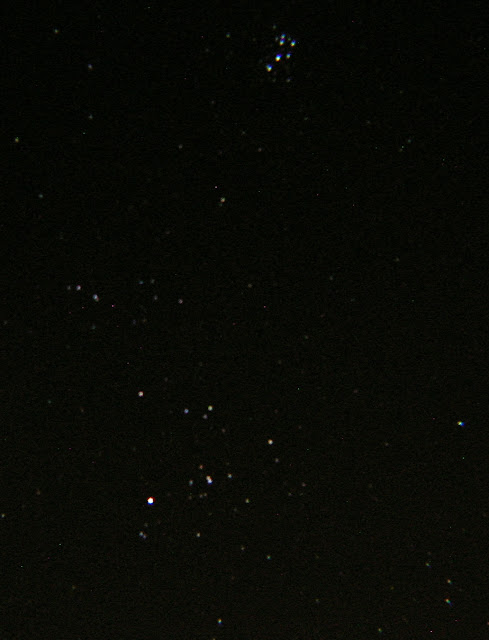
“V” may be for Victory, but it’s also the shape of one of the closest star clusters to Earth: the Hyades. Located in the constellation Taurus, finding this star cluster is easy-peasy - the brightest stars in the cluster make a distinctive 'V' or arrowhead shape and it is located south of its more well-known half sisters, the Pleiades, or Seven Sisters. The Hyades are 'only' about 150 light years from our solar syste - the Pleiades, for example, is three times farther or about 400 light years away.

The first star to catch your eye in that V shape will be a bright orange spark to the bottom left - the 'eye' of the Taurean bull. This is the red giant pictured below, Aldebaran  - a star that is approximately 50 times the diameter of our Sun.   Aldebaran is actually not part of the Hyades star cluster at all. It’s only 65 light years from Earth (that is, almost halfway between us and the Hyades) but coincidentally happens to be in the foreground of our line of sight to the Hyades. That said, without Aldebaran, the cluster would be a little disappointing; so it does adds a little lustre to it and helps anchor the overall shape of the cluster for us astronomers. The name Aldebaran actually comes from Arabic (al-dabaran) and translates literally as "the follower", presumably because this bright star appears to follow the Seven Sisters in the night sky - in which case, perhaps 'Stalker' might have been a better word! For the Seris of northwestern Mexico, Aldebaran is said to provide light for the seven 'women' giving birth. And those Trekkers among you probably know of one of Scotty's favourites, the Aldebaran whiskey and the Aldebaran mud leeches used by the Denobulan Dr Phlox!


The Hyades contains about 20 orange and blue stars that are perhaps visible to the naked eye; If you like double and binary stars, you'll love Hyades - as you can see from the image below, the Hyades cluster has quite a few pairs in it. Even with average eyesight, you can probably make out and split with tree pairs without any difficulty - the Sigmas (just a little to the south pf Aldebaran), the Thethas (to the east) and the Kappas (way up north).


While  the cluster appears like the letter “V” from our perspective on Earth, its true shape is approximately spherical.  And while we may be able to observe about 20 stars visually, the Hyades actually contains some 300-400 stars. Below is a 'stacked' enhancement of the image above, which clearly show a lot more stars than is evident at first.


All photographs on this page  © Sabri Zain 2012.